Time Management Tips for the Exam Hall
The clock is often the real opponent, not the questions. A few simple rules keep you from running out of time on easy marks.
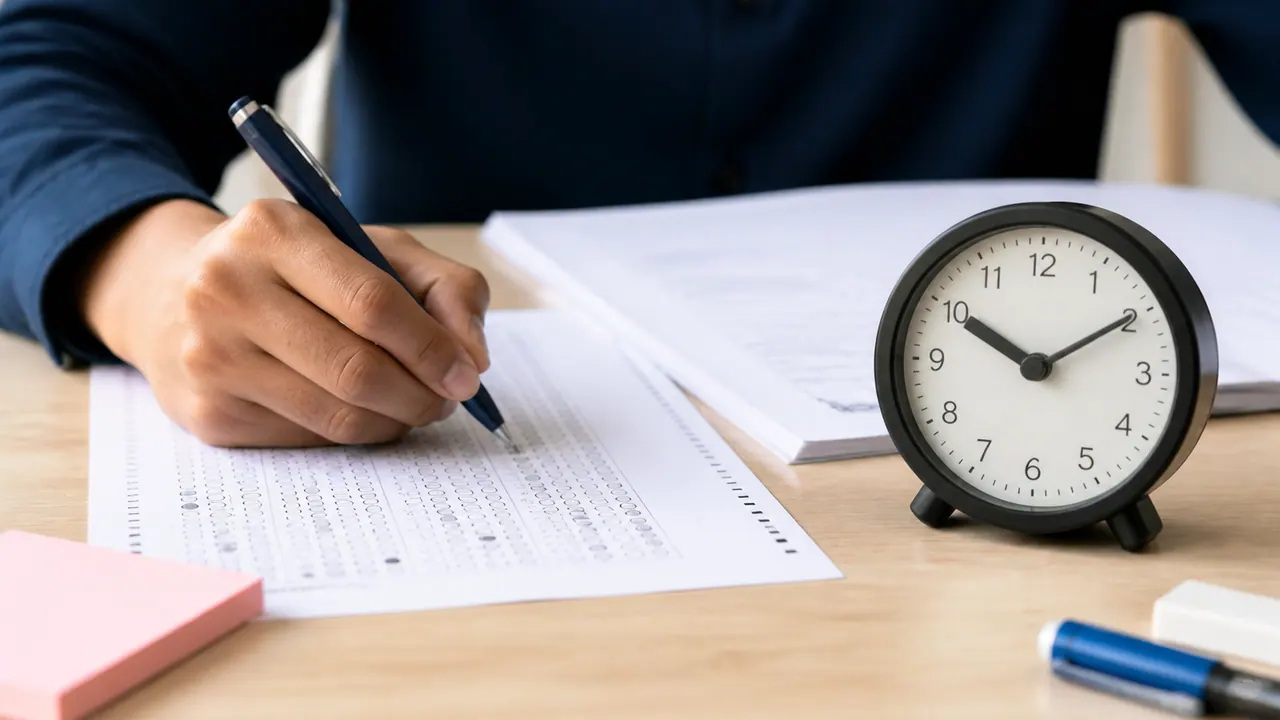
Time management during the exam is often the real skill gap, not subject knowledge: it's common to know the material well and still lose marks purely to poor time allocation, spending too long on one tough question while easier ones go unanswered. A little structure fixes most of this.
- On your first pass, only answer what you can solve in 30 to 40 seconds; mark the rest and move on.
- Check your progress against the clock at section-level checkpoints, not just at the end.
- In the final minutes, prioritize unattempted questions over ones you've already sunk time into.
- Practice under real time limits regularly; untimed practice doesn't build exam-day pacing.
Do a fast first pass
On your first pass through a section, answer only what you can solve in under 30 to 40 seconds. Mark anything slower for review and move on immediately. Don't let one question eat the time budget for five others.
Set section-level time checkpoints
Divide the total time by section based on the number of questions and check your progress at each checkpoint, not just at the end. If you're behind by the halfway mark, that's your signal to speed up, not a surprise at the last five minutes. Whether you get to move that time around at all depends on your exam: see sectional lock vs composite timer if you're not sure which kind yours is.
An unattempted easy question is more recoverable than a hard one you've already sunk time into.
Save the last few minutes for unattempted, not unfinished
In the final stretch, prioritize questions you haven't looked at yet over ones you've already spent three minutes stuck on. An unattempted easy question is more recoverable than a hard one you've already sunk time into.
Practice against the clock, not just for accuracy
Untimed practice builds knowledge but not exam-day pacing. Take full-length mock tests under real time limits regularly so the pacing becomes automatic rather than something you're calculating mid-exam, then check your unattempted count in the results: how to analyze your mock test performance explains what that number is actually telling you.
Good pacing also does a lot to quiet exam-day nerves, since most of the panic comes from watching the clock run out, not from the questions themselves. See how to handle exam day anxiety for what else helps beyond pacing.
Put the strategy into practice
Choose a checked mock test and apply what you learned while the idea is fresh.
Frequently asked questions
How long should I spend on one question before moving on?
Roughly 30 to 40 seconds on your first pass through a section. If it is taking longer than that, mark it for review and move on immediately rather than letting one question eat the time budget meant for several easier ones.
Can I move leftover time from one section to another during the exam?
It depends on your exam. Some use a sectional lock where each section gets a fixed window and unused time never carries over, while others give one combined timer for the whole paper that you can split however you like. Check which kind your exam uses before assuming.
What should I do in the last few minutes of a timed section?
Prioritize questions you have not looked at yet over ones you have already spent several minutes stuck on. An unattempted easy question is more recoverable in a short window than a hard one you have already sunk time into.
Does untimed practice help with exam-day time management?
It builds knowledge but not pacing. Untimed practice will not teach you how a real countdown feels, so regular full-length mock tests under actual time limits are what actually make the pacing automatic.