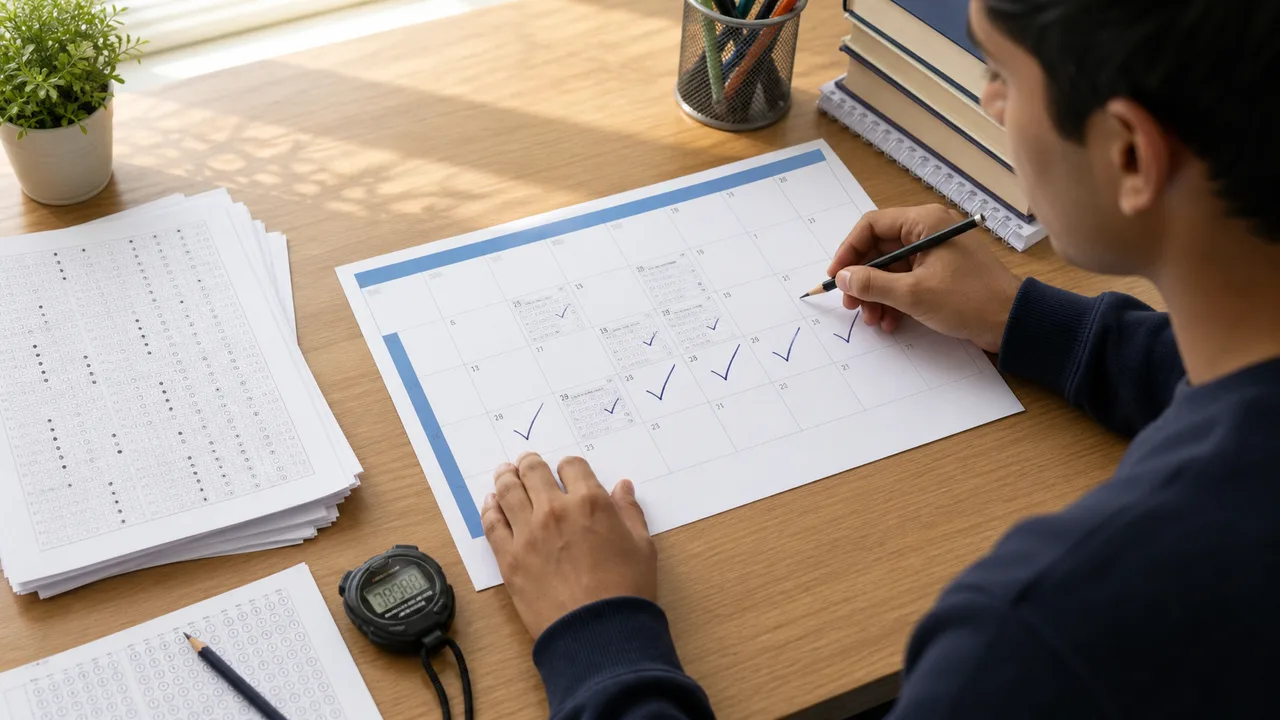
How to Analyze Your Mock Test Performance
A score alone tells you almost nothing useful. The section breakdown, the unattempted count and the trend across tests do.

It's easy to check a mock test score, feel a brief reaction, and move on to the next one. That skips the part that actually improves your next attempt: understanding why each mark was lost.
- Separate knowledge gaps from careless errors; they need completely different fixes.
- Check section-wise accuracy, not just the total score.
- A high unattempted count usually points to a pacing problem, not a knowledge problem.
- Look for a trend across several mock tests, not a single result.
Separate knowledge gaps from careless errors
For every wrong answer, ask whether you didn't know the concept, or knew it but made a silly mistake under time pressure. These need completely different fixes: one needs more study, the other needs slower, more careful reading.
Look at section-wise accuracy, not just total score
Two students can score the same overall total with very different section breakdowns. Your results page on this site breaks every attempt down by section specifically so you can see which one is actually dragging your score down.
Track your unattempted count over time
A high unattempted count usually means a pacing problem, not a knowledge problem: you're running out of time, not out of answers. If that number isn't shrinking test over test, revisit your exam-hall time management approach before adding more study material.
Improvement shows up as a trend across several mock tests, not a single lucky attempt.
Revisit the same weak section in your next test
Improvement shows up as a trend across several mock tests, not a single lucky attempt. Retake sectional tests in a section you scored poorly on and confirm the accuracy is actually moving before assuming you've fixed the gap.
If the gap is with the real paper rather than the sections
All of the above assumes the mock itself is a fair proxy. Where a practice score has been consistently higher than a real one, the explanation is usually in the material rather than in your nerves, and the four terms that cause it are measurable: why your mock score beats your real score.
This kind of review works best as a fixed weekly habit rather than something you do only when you remember to. See how to build a study timetable that actually works for where to slot it in.
Once your score is stable, the next question is usually how it compares to what you actually need. See understanding cutoffs and percentile for why last year's cutoff is a guide, not a fixed target.
Put the strategy into practice
Choose a checked mock test and apply what you learned while the idea is fresh.
Frequently asked questions
What should I look at first after a mock test besides my score?
Section-wise accuracy. The same total score can hide very different weak areas, so break the result down by section before deciding what to study next, not just the overall number.
How do I know if a wrong answer was a knowledge gap or a careless mistake?
Ask whether you did not know the concept at all, or knew it but slipped under time pressure. These need different fixes: a genuine gap needs more study, a careless error needs slower, more careful reading, not more content.
Does a high unattempted count mean I need to study more?
Usually not. A high unattempted count is more often a pacing problem than a knowledge problem, you are running out of time rather than running out of answers, so the fix is time management practice, not additional material.
How many mock tests before I can tell if I am actually improving?
Look for a trend across several attempts in the same section rather than judging from one test. A single good or bad score can be luck; consistent movement in section-wise accuracy over multiple tests is the real signal.