Practice by Topic Instead of by Exam
A full mock scatters a handful of questions per topic across a whole paper. The same corpus cut by topic gives you 8,746 questions across 40 topics.
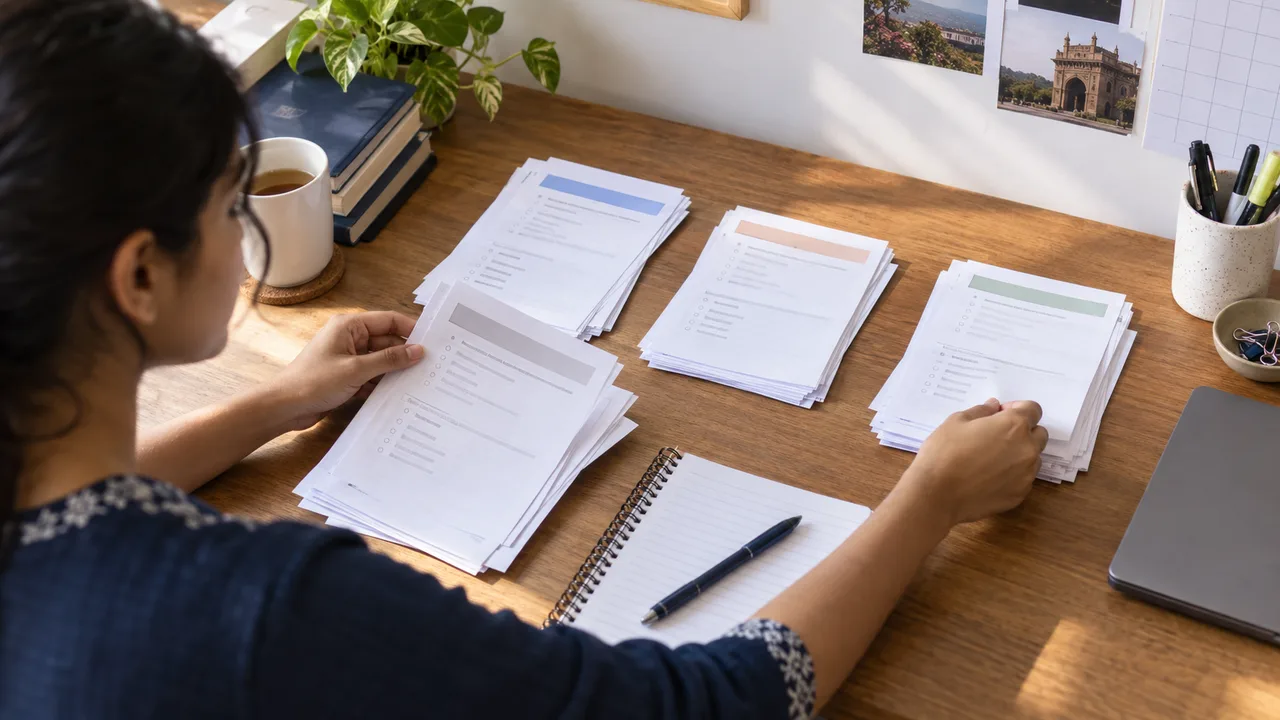
A full mock test is organised the way the exam is: a bit of everything, in the order the paper puts it. That is exactly right when you are rehearsing the exam. It is a poor way to fix one weak topic, because a single paper gives you only a handful of questions on it, spread through the sections, with the rest of the exam in between.
- Full mocks answer "am I ready?". Topic sets answer "why am I losing marks here?". They are different questions.
- The topic pages pool 8,746 questions across 40 topics, drawn from the same banks the mock tests use.
- Probability draws from 81 different exams, syllogism from 58, direction sense from 55.
- No negative marking on topic sets, so you can attempt everything and see what you actually know.
- Use the mock to find the weak topic, the topic set to fix it, then the next mock to check it stuck.
Why pooling across exams works
A percentage question does not become a different question because it appeared in a bank paper rather than a railway one. Neither does a syllogism, a coding-decoding puzzle, or an error-spotting sentence. The exam wrapper changes the marks, the timer, and the penalty, but the reasoning you have to do is the same. That is why a topic pool can be far deeper than any one exam's bank: probability on this site draws from 81 different exams, syllogism from 58, direction sense from 55.
A few topic pools, and how widely they draw
| Topic | Questions | Exams it draws from |
|---|---|---|
| Data Interpretation | 455 | 52 |
| Number Series | 404 | 50 |
| Coding and Decoding | 326 | 50 |
| Syllogism | 313 | 58 |
| Direction Sense | 283 | 55 |
| Time, Speed and Distance | 198 | 48 |
Where pooling does not work
The same logic breaks completely for General Awareness and current affairs, so those are not pooled here. A question about a state's recruitment rules or last quarter's appointments is not exam-agnostic in any useful sense, and pretending otherwise would produce a pile of questions that is wrong for almost everybody reading it. Anything whose answer depends on who is recruiting, or on when you are reading, stays inside its own exam.
The mock tells you which topic is costing you marks. It is a slow and expensive way to then practice that topic.
How to actually use the two together
Take the full mock first, under real timing and real negative marking, because that is the only thing that tells you where you stand. Then read the result by topic rather than by score. Whatever comes out worst, drill it on its own until the method is automatic, and only then take the next full mock to confirm it held under time pressure. How to analyze your mock test performance covers the reading step; how to build an error log covers keeping track of what keeps recurring.
Why there is no negative marking on topic sets
Guessing penalties exist to stop you answering questions you do not understand. That is a sensible rule in an exam and a counterproductive one in practice, where an attempted-and-wrong question is more useful to you than a blank one: it tells you exactly which step you got wrong. So topic sets carry 1 mark per question and no penalty. When you want to rehearse the risk calculus instead, go back to your exam's own mock, where the real marking scheme applies.
Browse the full list at topic-wise practice. If reasoning specifically is what you are after, logical reasoning practice grades the same kind of questions from easy to hard on one scale, so you can work up a ladder rather than pick a topic.
Put the strategy into practice
Choose a checked mock test and apply what you learned while the idea is fresh.
Frequently asked questions
Should I do topic-wise practice or full mock tests?
Both, in that order of use: the full mock tells you where you are losing marks, the topic set is where you fix it, and the next full mock is where you check the fix held under time pressure. A mock is a bad practice tool for a single topic because it gives you only a handful of questions on it, scattered through the paper.
Do topic-wise questions come from real exam papers?
They are drawn from the same original question banks that power the mock tests on this site, pooled by topic instead of by exam. They are original practice questions written to each exam's published syllabus, not reproductions of a past paper.
Why is there no negative marking on topic practice?
Because the point is to find out what you know, not to rehearse guessing risk. An attempted-and-wrong question tells you which step you got wrong; a blank one tells you nothing. Every question carries 1 mark and no penalty. For the real risk calculus, use your own exam's mock, where its actual marking scheme applies.
How many questions are in the topic practice section?
8,746 questions across 40 topics. Pool sizes vary by topic: number series has 404, syllogism 313, time, speed and distance 198. A topic is only published once it has at least 50 questions behind it.
Is topic practice useful if my exam has negative marking?
Yes, for building the method. Practise the topic without a penalty until the approach is automatic, then rehearse it under your exam's real marking scheme in a sectional or full mock. Trying to learn a topic and manage guessing risk at the same time usually means doing neither well.