How to Build an Error Log and Actually Use It
A single mock test review tells you what went wrong once. An error log, kept and reviewed across every test, tells you what keeps going wrong.
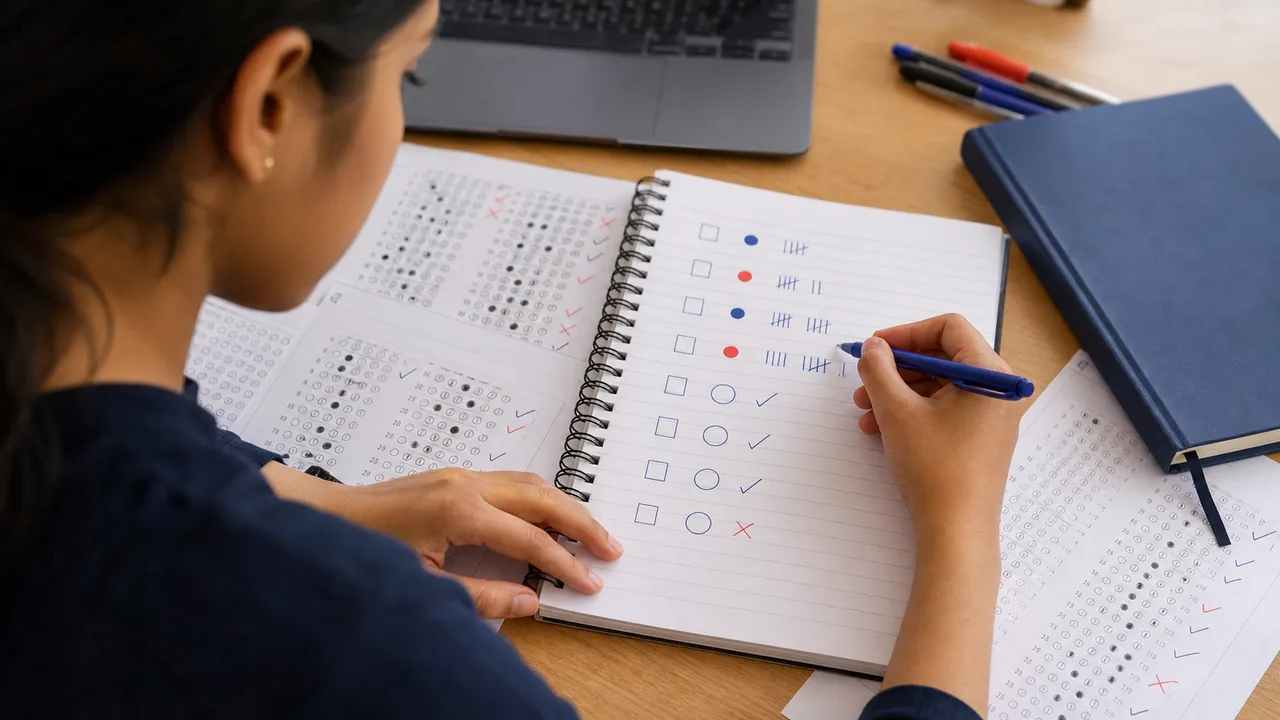
An error log, a running record you keep across every test you take, tells you what keeps going wrong, which is different from reviewing a single mock test, which only tells you what went wrong on that one test. That distinction matters, because a mistake that shows up once is noise; a mistake that shows up in four out of your last five tests is a pattern worth fixing directly.
What actually belongs in an error log
Keep it simple enough that you will actually maintain it: for every question you got wrong or left blank, note the topic, why you missed it in one short phrase (calculation slip, misread the question, did not know the concept, ran out of time), and the date. That third field, the reason, is what turns a list of wrong answers into a diagnostic tool.
Four common reasons, and what each one actually needs
| Reason you missed it | What it usually means | What actually fixes it |
|---|---|---|
| Did not know the concept | A real gap in preparation | Go back to the topic and relearn it, not just note the correct answer |
| Misread the question | A reading or attention slip, not a knowledge gap | Practice reading the full question before looking at the options |
| Calculation or careless slip | Rushed execution under time pressure | Slow down slightly on that question type specifically, not across the board |
| Ran out of time | A pacing problem, not an accuracy problem | Review your section-wise timing, not the specific question content |
- Log the topic, the reason you missed it, and the date for every wrong or skipped question, not just the correct answer.
- The reason field is what turns a wrong-answer list into a pattern you can actually fix.
- Review the log before every new mock test, not just after, so you watch for the same mistake recurring.
- A topic or reason that keeps repeating across tests is worth a dedicated study session, not another note in the log.
A mistake that shows up once is noise. A mistake that shows up in four out of your last five tests is a pattern worth fixing directly.
Review it before your next test, not just after this one
Most aspirants only open their error log right after a mock, while it is fresh, and then forget it exists until the next review session. Flip that habit: skim your log for five minutes before starting your next mock too. Seeing "I keep misreading data interpretation questions" right before you sit down for another test makes you noticeably more alert to that exact failure mode while it is happening, not just after.
Watch for the same reason recurring across different topics
A pattern is not always tied to one topic. If "ran out of time" or "calculation slip" keeps appearing across several unrelated topics, the fix is not more content review, it is a pacing or accuracy habit that needs direct attention on its own. Speed versus accuracy covers how to tell which of those two you are actually dealing with.
An error log works alongside, not instead of, a full test review. Use how to analyze your mock test performance for the single-test breakdown, and let the error log show you what repeats across tests over time.
Put the strategy into practice
Choose a checked mock test and apply what you learned while the idea is fresh.
Frequently asked questions
What should I actually write down in an error log?
For every question you got wrong or left blank, note the topic, a short reason you missed it (did not know it, misread it, calculation slip, ran out of time), and the date. The reason is what makes the log useful, not just the topic.
How is an error log different from reviewing a single mock test?
A single test review shows what went wrong on that one attempt. An error log, kept across every test, shows which mistakes keep recurring over time, which is what tells you what is actually worth fixing.
When should I review my error log?
Both after a test, while the mistakes are fresh, and briefly before your next test, so you go in aware of the pattern you are watching for. Most aspirants only do the first and skip the second.
What if the same mistake keeps showing up across different topics?
That usually means the issue is not the content itself but a habit like pacing or careless slips under time pressure. That needs direct practice on the habit, not more revision of the topics where it happens to show up.