Understanding Negative Marking: A Complete Guide
Negative marking changes the optimal strategy for guessing. Once you can rule out one option of four, a guess usually beats leaving it blank.
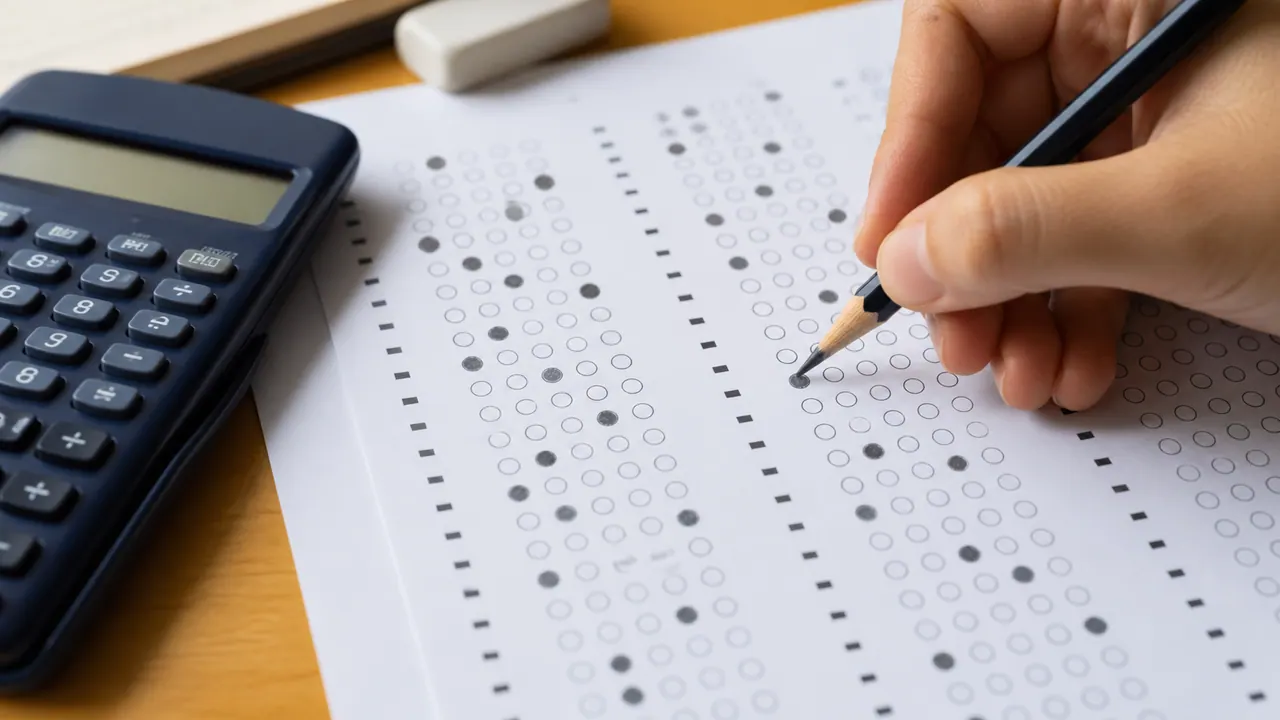
Negative marking means an incorrect answer costs you marks, not just a missed opportunity. So the right strategy isn't "always attempt everything" or "never guess," it's somewhere in between, and the math is simple once you see it.
- Unattempted questions always score zero; only a wrong answer costs you marks.
- The deduction is not the penalty. Divide it by the marks a correct answer earns, because 1 mark off a 4-mark question is the same cost as 0.25 off a 1-mark question.
- Check before you assume there is a penalty at all: 421 of the 1,440 tests here deduct nothing.
- A guess breaks even at the deduction divided by (marks per correct answer plus the deduction). On the commonest scheme here that is 20%, and a blind guess between four options returns 25%.
- Leaving a question blank because you are unsure costs you marks on most papers. The reason to skip one is the time it takes to decide, not the penalty.
How it works
Two numbers govern the whole decision: what a correct answer earns, and what a wrong one takes away. The second divided by the first is what a wrong answer really costs you, and it is the only figure worth carrying into the exam hall. Across the 1,440 checked tests on this site the commonest answer is a quarter of a correct answer, on 716 of them. Read both numbers off your exam's exam pattern page rather than assuming they match an exam you have already prepared for. Unattempted questions score zero either way, so the only real risk is answering incorrectly.
How the 1,440 tests on this site actually score
| A wrong answer costs | Tests here | Written on the paper as |
|---|---|---|
| A quarter of a correct answer | 716 | +1/-0.25, +4/-1, +2/-0.5 and four other ways |
| A third of a correct answer | 279 | +1/-0.333, +3/-1, +2.5/-0.833 and four other ways |
| Nothing | 421 | No deduction is stated |
| Some other share | 24 | Mostly one-eighth and one-fifth schemes |
The deduction on its own tells you nothing
"One mark will be deducted for each wrong answer" sounds precise and is not. What a wrong answer costs you depends entirely on what a correct one earns, and that is the number students skip. On the tests published here a stated deduction of 1 mark means three different penalties depending on the paper, and so does a stated deduction of 0.25. Divide the deduction by the marks per correct answer before you decide anything about guessing.
One deduction figure, more than one penalty
| Deduction stated | A correct answer earns | So a wrong answer really costs | Tests here |
|---|---|---|---|
| 0.25 marks | 1 mark | A quarter of a correct answer | 405 |
| 0.25 marks | 2 marks | An eighth of a correct answer | 12 |
| 0.25 marks | 1.5 marks | A sixth of a correct answer | 2 |
| 0.5 marks | 2 marks | A quarter of a correct answer | 110 |
| 0.5 marks | 3 marks | A sixth of a correct answer | 2 |
| 1 mark | 4 marks | A quarter of a correct answer | 170 |
| 1 mark | 3 marks | A third of a correct answer | 95 |
| 1 mark | 5 marks | A fifth of a correct answer | 6 |
Where there is no penalty, a blank is a wasted mark
Not every paper deducts. Of the 1,440 checked tests published here, 421 take nothing off for a wrong answer, roughly 29 in every hundred. On those the guessing question does not arise. A blank scores zero and a wrong answer scores zero, so every question you leave unanswered is a mark you declined to try for, and the disciplined habit that protects you on a penalty paper costs you marks here. That is why neither "attempt everything" nor "never guess" works as a general rule: they are each correct on a different set of papers, and you have to know which one you are sitting.
When a guess is worth it
There is an exact line, and it is lower than most students assume. With +m for a correct answer and −n for a wrong one, a guess breaks even when your accuracy equals n divided by (m + n). Below that a guess costs you marks on average. Above it, it gains them. Run the commonest scheme on this site, +1 and −0.25, and the line sits at 20%. A blind guess between four options is right 25% of the time, which is already past it. On a one-third penalty the break-even is exactly 25%, so blind guessing gains and loses nothing across a long paper, and ruling out a single option tips it into profit. Every scheme published here has its break-even at or below that 25%, so eliminating one of four options is always worth an answer. How to rule out an option covers how to find that one.
So the real reason to leave one blank is time
That makes "skip it if you are not sure" the wrong default on most papers here. A guess you make in three seconds is close to free; one you spend forty seconds talking yourself into is expensive, and the forty seconds is the cost rather than the fraction of a mark. Count the options too. Five of them drop a blind guess to 20%, which takes a quarter-penalty paper from slightly positive to exactly break-even, and a few exams here do set five. Your exam's exam pattern page states the break-even for that paper from its own official scheme, and the questions you cannot guess covers the answer types where none of this arithmetic applies at all.
Why this matters more than most students think
A handful of careless guesses can erase the marks gained from your strongest section without ever showing up as a weak section. Treat "should I guess this?" as a real decision each time, not a reflex, and review your mock test results specifically for wrong answers on questions you weren't sure about; how to analyze your mock test performance covers how to separate those from genuine knowledge gaps.
A handful of careless guesses can erase the marks gained from your strongest section without ever showing up as a weak section.
This is one of 5 common mistakes in SSC CGL preparation worth checking yourself against directly, since ignoring the exact deduction on your exam is a surprisingly frequent, entirely avoidable one.
Put the strategy into practice
Choose a checked mock test and apply what you learned while the idea is fresh.
Frequently asked questions
How much does a wrong answer typically cost in negative marking?
Ask what fraction of a correct answer it costs, not how many marks come off. Across the 1,440 checked tests on this site, 716 take off a quarter of a correct answer and 279 take off a third, which between them covers most SSC, banking and railway papers. A further 421 take off nothing at all. Marks per question vary far more than the fraction does, so check your own exam's pattern page rather than assuming.
Should I ever leave a question completely unattempted?
Less often than most advice suggests, and for time rather than for marks. A guess breaks even when your accuracy matches the deduction divided by (marks per correct answer plus the deduction). On the commonest scheme here, +1 with a 0.25 deduction, that is 20%, while a blind guess between four options returns 25%, so it is already worth taking. Leave a question alone when working out that you cannot eliminate anything would cost more time than the question is worth.
Is it worth guessing if I can eliminate one wrong option?
Yes, on every scheme published here. Ruling out one of four options leaves you guessing among three, which is right about 33% of the time. The harshest penalty on this site is one-third of a correct answer, and its break-even is 25%, so 33% clears every break-even the site publishes. Eliminating an option always makes the guess worth taking.
Do unattempted questions lose marks under negative marking?
No. Unattempted questions always score zero, the same as they would under any marking scheme. The penalty applies only to answers you get wrong, which is exactly why guessing needs to be a deliberate decision rather than a reflex.
Is a 1-mark deduction worse than a 0.25-mark deduction?
Not necessarily, and on this site it usually is not. What matters is the deduction divided by the marks a correct answer earns. A paper scoring +4 for a correct answer and taking 1 mark off for a wrong one applies exactly the same penalty as a paper scoring +1 and taking off 0.25. Both cost you a quarter of a correct answer. A deduction of 1 mark is a third of a correct answer on a +3 paper and a fifth on a +5 paper, so the figure on its own is not comparable across exams.
How many exams have no negative marking?
421 of the 1,440 checked tests on this site deduct nothing for a wrong answer, which is about 29 percent of them. On a paper with no penalty there is no reason to leave anything blank, since an unanswered question and a wrong one both score zero. Check your own exam's pattern page rather than assuming, because the rule can differ between stages of the same exam.