Spaced Repetition: How to Actually Remember What You Study
Reviewing something once and moving on feels productive, but most of it is gone within days. Spacing out review is what actually makes it stick.
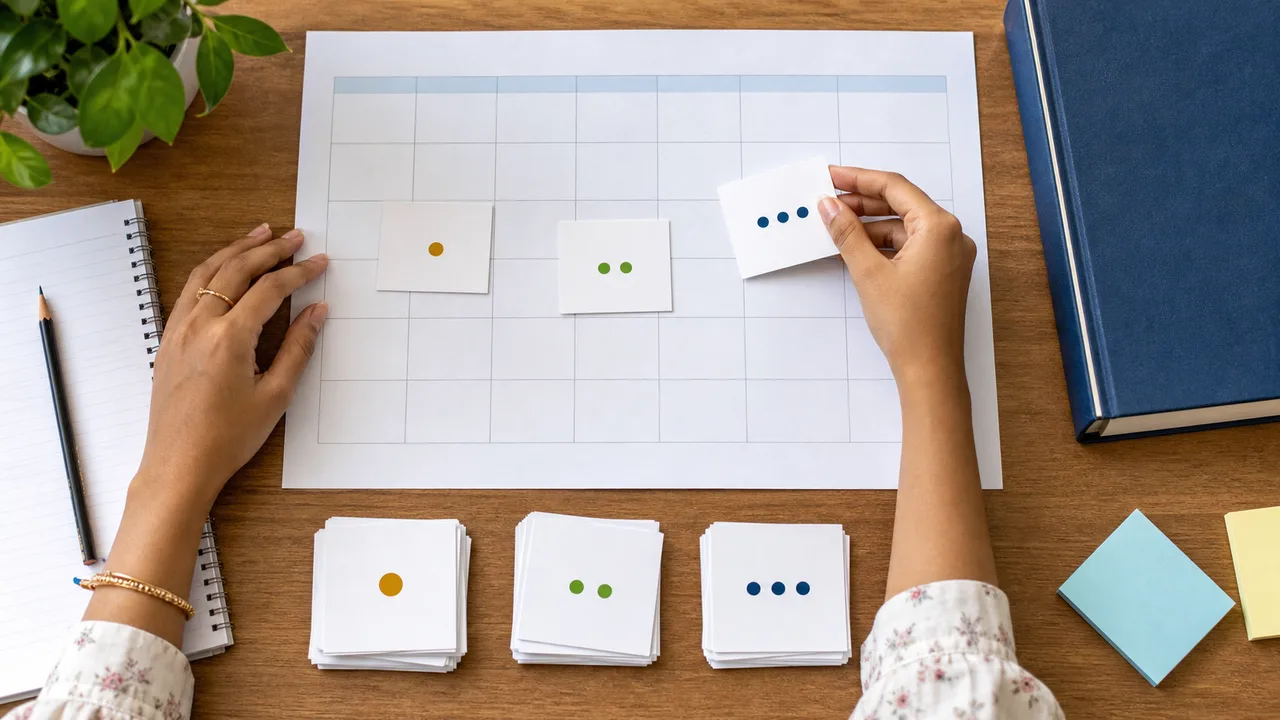
Spaced repetition, reviewing material again at increasing intervals instead of just once, is one of the highest-return habits an aspirant can build into an otherwise ordinary study routine. It works on an ordinary property of memory: most new information fades fast without reinforcement, and a large share of what you study today, if reviewed only once, is gone within days.
Why a single review session is not enough
Reading a topic once, understanding it in the moment, and moving on feels like progress, and in the short term it is. But memory without reinforcement decays quickly, and by the time you circle back weeks later during revision, much of it needs to be relearned almost from scratch. That relearning is wasted effort you could have avoided with two or three short review sessions spread out over the weeks in between instead of one long session up front.
- Review new material again within a day or two of first learning it, not weeks later.
- Space subsequent reviews further apart each time: a few days, then a couple of weeks, then a month.
- Active recall, testing yourself, works better than passive rereading at each review point.
- Apply this to formulas, vocabulary, and static GK facts; it is less useful for skills that need repeated practice instead.
The basic pattern: short, then longer, gaps
A simple spaced-repetition schedule reviews new material the next day, again after about a week, and again after two to four weeks. Each successful review signals that the information has moved further into stable memory, which is why the gap between reviews grows over time instead of staying fixed. You do not need a dedicated app to do this: a simple running list of what you studied and when, checked against a calendar, works just as well for most aspirants.
Each successful review signals that the information has moved further into stable memory, which is why the gap between reviews grows over time instead of staying fixed.
Testing yourself beats rereading your notes
At each review point, trying to recall the fact or formula from memory first, before checking your notes, is more effective than simply rereading the same page again. This is active recall: the effort of retrieving something from memory is itself what strengthens that memory, in a way that passive rereading does not replicate no matter how many times you repeat it. A quick self-quiz using your own notes, or revisiting a mock test question you got wrong, works for this just as well as any dedicated flashcard tool.
Where this helps most, and where it does not
Spaced repetition works especially well for discrete facts: vocabulary, static GK, formulas, and constants, the kind of material covered in preparing General Awareness without drowning in current affairs and building vocabulary without rote memorization. It matters less for skills that improve mainly through repeated practice under time pressure, like solving reasoning puzzles or calculation-heavy quantitative questions, where regular mock-test practice does more of the work than spaced review of any single fact.
Once spaced review is part of your routine, how to build a study timetable that actually works covers how to fit short review sessions into an already full weekly schedule without them crowding out new material.
Put the strategy into practice
Choose a checked mock test and apply what you learned while the idea is fresh.
Frequently asked questions
What is spaced repetition and how is it different from normal revision?
Spaced repetition means reviewing material again at increasing intervals, a day later, then a week, then a month, instead of studying it once and revisiting it only during a general revision phase weeks or months later.
Do I need an app to use spaced repetition?
No. A simple running list of what you studied and when, checked against a calendar, works for most aspirants. Dedicated flashcard apps can help but are not required to get the benefit.
Is spaced repetition useful for every subject in a competitive exam?
It works especially well for discrete facts like vocabulary, static GK, and formulas. It matters less for skills built mainly through repeated practice, like solving reasoning puzzles or calculation-heavy questions, where regular mock-test practice does more of the work.
Why does testing myself work better than rereading my notes at each review?
The effort of retrieving a fact from memory, called active recall, is what strengthens that memory. Passive rereading does not produce the same effect, even if you repeat it several times.